

Nobody Thinks Alone
Nobody thinks alone.
Neither do organizations.
AI is changing what each of us can do alone.
But when individual work changes, something else begins to move: the way people interact, the knowledge they exchange, the decisions they make, and eventually the organization itself.
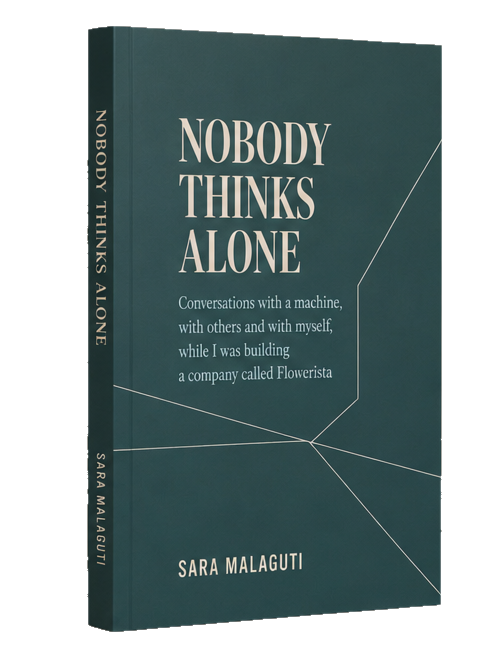
Nobody Thinks Alone is the project that brings together the book written by Sara Malaguti, a research lens and an evolving framework for understanding these changes before deciding how to intervene.
01 — The book
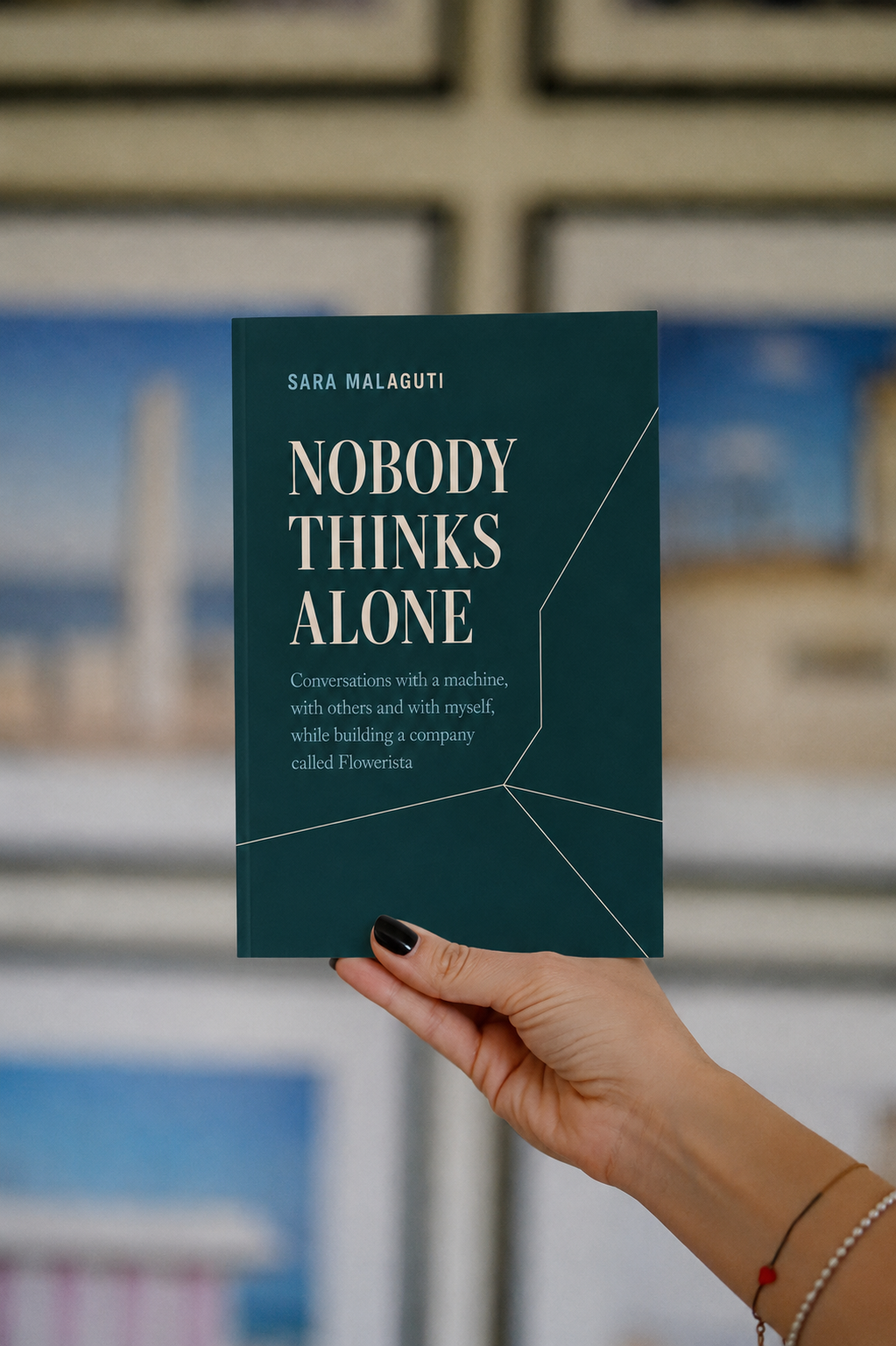
Nobody Thinks Alone
What happens to our thinking when one of the voices we think with is no longer human?
We are used to thinking of thought as an individual practice. Nobody Thinks Alone begins, provocatively, from the opposite assumption: it never really has been, because we have always thought with others. Other people give us language, challenge our interpretations, shift our perspective and leave traces in the way we see the world, even when we believe we are thinking alone.
AI has entered this space.
For the first time, part of the dialogue through which we develop ideas, make decisions and understand ourselves can happen with a machine that is always available, extraordinarily responsive and increasingly capable of remembering our context.
The book follows eighteen situations experienced by the author while she was building Flowerista: conversations with colleagues, clients, other people and AI in which what seemed settled had to be reconsidered.
Flowerista is the organizational laboratory where these questions take shape in practice. From those situations emerges a question that eventually becomes larger than the book itself.
If nobody thinks alone, how does an organization think?
02 — From people to organizations
AI enters organizations through people.
A new technology may be introduced at organizational level. Its effects rarely begin there.
They begin when someone discovers that a task can now be done differently.
Imagine a proposal that used to take four hours and a conversation with a colleague. With AI, one person can produce a strong first version in forty minutes.
At first, this looks like an individual productivity gain. But the colleague who used to be involved no longer sees the work.
- A conversation disappears.
- A piece of knowledge stops circulating.
- A decision that used to be shared becomes individual.
If this happens once, very little changes. If it happens hundreds of times across an organization, the organization begins to change.
INTERACTIVE KNOWLEDGE MAP
Enter through the connections.
Move through the book, its core ideas, the Micro–Meso–Macro framework and the Organizational Second Brain. Each point opens the relationships around it.
03 — Micro / Meso / Macro
The same change can exist at three different scales.
Micro
The person
What changes in the way an individual works, decides, learns or uses AI?
Meso
The interactions
What changes between people? Where does knowledge circulate? Where does it stop? Which conversations disappear? Which new dependencies emerge?
Macro
The system
What becomes persistent? Processes, rules, decision rights, shared language, infrastructure and organizational memory.
The three scales do not simply add up.
A company may formally encourage knowledge sharing while its everyday interactions keep knowledge inside a few relationships.
People may develop extraordinary ways of working with AI while the organization remains unable to learn from them.
A sophisticated knowledge infrastructure may exist while the most valuable knowledge still travels through conversations that leave no trace.
The distance between the three levels is often where the most important information lies.
04 — What does the organization know?
An organization can know more than any one of its people knows — and still be unable to see what it knows.
Knowledge exists in documents and databases. It also exists in conversations, exceptions, decisions, disagreements, client relationships and in the experience of people doing the work.
As AI changes how people work and interact, it also changes how this knowledge moves. Some things become easier to capture. Others stop circulating because the interaction through which they used to travel has disappeared.
Some knowledge remains inside individual AI conversations. Some reaches the organization but loses the context that made it meaningful.
This creates a different question for AI adoption:
What is becoming visible to the organization — and what is becoming invisible?
05 — Organizations need to remember change
To understand what we know now, we need to reconstruct how we got here.
Knowing the current state of something is useful. Sometimes the more valuable knowledge is understanding how we got there.
- A client was initially understood in one way.
- New evidence appeared.
- Someone challenged that interpretation.
- The organization changed its understanding.
- A different decision followed.
- Later, reality showed whether that decision worked.
This history matters, because organizations learn when experience can modify what they previously believed to be true. So we look at where knowledge sits, and at how it changes:
This is where organizational memory becomes more than information storage. It becomes part of an organization's capacity to learn.
06 — The framework
We look for changes that move across scales.
The Micro–Meso–Macro framework grew out of the situations described in Nobody Thinks Alone and from our work inside organizations.
We use real episodes rather than abstract descriptions of how the organization is supposed to work.
The goal is to make the organization more legible to itself before deciding what AI should amplify.
Then we follow what happened
- Where did the knowledge originate?
- Who could see it?
- How did it move?
- Where did it stop?
- What changed when people interacted?
- What survived?
- What did the organization learn?
07 — From observation to intervention
We don't start with the technology.
We start with what is actually happening at work. From there, the work can move through different stages:
01Cases & evidence
We start from real episodes and the traces they leave behind: conversations, documents, decisions, work handoffs, and outcomes. We reconstruct what actually happened before forming a diagnosis, keeping the framework anchored in real work rather than in a generic maturity score.
02Micro / Meso / Macro
We observe the same change in three places: the person, the interactions between people, and the organizational system. This helps us see where a behavior begins, how it propagates, and how rules, processes, and infrastructures feed back into it.
03Organizational maps
Evidence is organized into maps that make knowledge circulation, dependencies, decision paths, memory, and friction visible. They are different views of the same system, designed to reveal patterns that would remain fragmented if we looked only at individual episodes.
04Diagnosis
The maps allow us to identify the patterns that matter: what works only locally, where knowledge stops, which dependencies are forming, and which behaviors are becoming structural. The diagnosis sets the priorities for intervention.
05Cognitive requirements
We translate the diagnosis into capabilities the organization needs to sustain: emergence of what it knows, circulation of knowledge, composition across different perspectives, sedimentation of what should persist, verification of what may no longer be valid, and openness to what it does not yet know.
06Intervention
Only then do we design the change. The intervention may concern work practices, decision responsibilities, collaboration, communication, AI use, processes, or organizational memory. The lever follows the pattern we observed rather than a standard solution.
07Technology, when it is part of the answer
Once the problem and cognitive requirements are clear, we assess whether technology is needed. The answer may involve connecting sources, building organizational memory, or using knowledge graphs, RAG, and AI agents. In other cases the answer is organizational and no new technology is required.
The intervention may concern the way decisions are made, how knowledge moves between functions, where responsibilities sit, how people work with AI, or how organizational memory is maintained.
Sometimes the answer requires technology. Sometimes it doesn't.
08 — What comes next?
The Organizational Second Brain
An organization continuously produces knowledge as it works. Some of it lives in people, some in conversations, projects, documents, decisions and the tools used every day.
The problem is that this knowledge often remains scattered, difficult to connect, or accessible only to those who already know where to look.
An Organizational Second Brain is a shared cognitive infrastructure that helps an organization make visible, connect, preserve and reactivate what it knows and what it learns while working.
How it is designed depends on its purpose. It may support organizational memory, onboarding, knowledge circulation across teams, the connection of signals from different sources, coordination, verification of what the organization believed to be true, or decision-making with richer context.
It can exist at the level of the whole organization while offering different views, access points and ways of querying it depending on who is using it.
The goal is to prevent what the organization learns from remaining trapped where it first emerged, and to make it available for further use, discussion and revision.
What it can support
When to use it
Whenever you need to recover context, connect scattered knowledge or reactivate what the organization has already learned.
The questions change depending on who is using it and why. The same infrastructure can help a CEO reconstruct a decision, a salesperson understand the history of a client, a creative explore past campaigns and concepts, or a new team member quickly find their way through the context.
It does not decide for the organization. It increases its capacity to see, remember, connect and revise what it knows.
09 — Bring the conversation into your organization
Start with a question.
Not every organization needs an assessment. Sometimes it needs a question strong enough to change the conversation.
I work with leadership teams, companies and institutions through keynotes and extended conversations built around the questions behind Nobody Thinks Alone.
Possible starting points
How is AI changing the way we think at work?
What happens to an organization when people need each other less to produce?
What should remain human when AI becomes part of everyday decision-making?
If nobody thinks alone, how does an organization think?
10 — Start with what is happening
Something has already started to change.
- —Perhaps people are using AI in very different ways.
- —Knowledge is becoming concentrated somewhere unexpected.
- —Teams are producing more but interacting less.
- —A process works on paper and breaks in practice.
- —AI adoption is advancing faster than the organization can understand its consequences.
This is where Flowerista enters.
We work with organizations to observe what is happening across people, interactions and systems, understand which patterns matter and design what should happen next.
11 — Flowerista
Flowerista is the laboratory where this work began.
We work on AI adoption from inside organizational life: where technology meets existing habits, relationships, knowledge and decision-making.
The framework grew first from observing our own organization while AI was changing it, and then from bringing the same questions into our work with clients.
That is why our starting point remains deliberately simple:
Before asking what AI can do for an organization, we want to understand what kind of organization it is entering.
12 — About the author
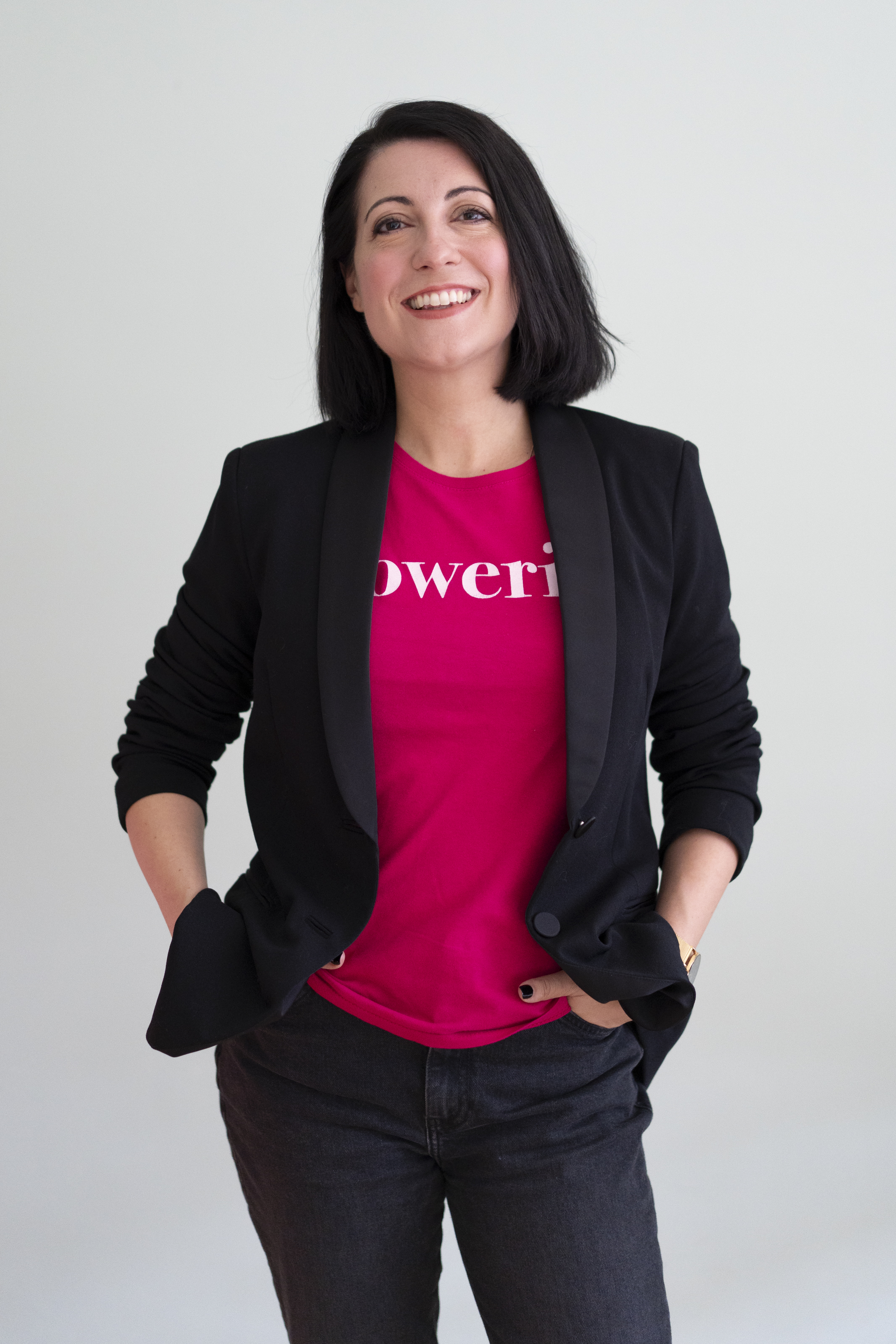
Sara Malaguti
My work sits at the intersection of humanistic thinking, technology and organizational research. I am the founder and CEO of Flowerista and the author of Nobody Thinks Alone.
My background moves across humanities, economics and organizations. Before founding Flowerista, I spent more than eight years at London Stock Exchange Group.
Today my work focuses on what happens when AI enters the cognitive and relational infrastructure of organizations: how people think, how knowledge circulates and how individual changes become systemic.
Nobody Thinks Alone is the book through which I began putting these questions into practices.
13 — Two ways in
Two ways to enter Nobody Thinks Alone.
Start with a question.
Bring the ideas behind the book into your organization through a keynote, leadership conversation or workshop.
Start with what is happening.
Bring us a real change, tension or situation inside your organization. We will help you understand what is happening across Micro, Meso and Macro — and what to do next.